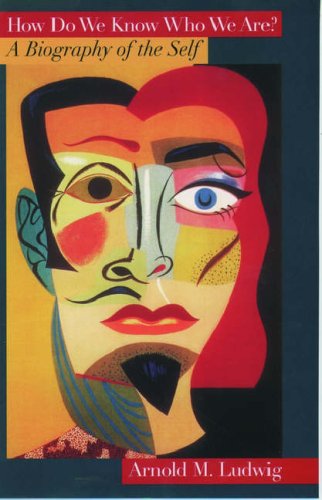
"The terrain of the self is vast," notes renowned psychiatrist Arnold Ludwig, "parts known, parts impenetrable, and parts unexplored." How do we construct a sense of ourselves? How can a self reflect upon itself or deceive itself? Is all personal identity plagiarized? Is a "true" or "authentic" self even possible? Is it possible to really "know" someone else or ourselves for that matter? To answer these and many other intriguing questions, Ludwig takes a unique approach, examining the art of biography for the insights it can give us into the construction of the self. In The Biography of the Self , he takes readers on an intriguing tour of the biographer's art, revealing how much this can tell us about ourselves. Drawing on in-depth interviews with twenty-one of our most esteemed biographers--writers such as David McCullough (the biographer of Truman and Theodore Roosevelt), Wallace Stegner (John Wesley Powell), Gloria Steinem (Marilyn Monroe), Leon Edel (Henry James), Peter Gay (Freud), Diane Middlebrook (Anne Sexton), and many others--and interweaving fascinating observations of his own practice, Ludwig takes us through the labyrinthine hall of mirrors we term the self and shows us how malleable, elusive, and paradoxical it can be. In chapters such as "The 'Real' Marilyn," "Psychoanalyzing Freud," "How Did Hitler Live With Himself?" and "What Madness Reveals," we sit in as biographers talk not only about their work, but about their subjects (Allan Bullock on Hitler and Stalin, for instance, or Arnold Rampersad on Langston Hughes) and how their subjects saw themselves. Ludwig describes how biographers must impose a narrative structure on their subjects' lives to create order out of a mass of often contradictory views, baffling behavior, and inconsistent self-representations, much in the same way that psychotherapists try to foster self-awareness and understanding in their patients. In his concluding chapter, Ludwig introduces a new concept--biographical freedom--which brilliantly reconciles free will and determinism. We can, he asserts, become biographers of ourselves. Like the biographer, we are constrained to consider all the available facts of our lives--the personal experiences, cultural forces, and predetermined scripts that shape us--but we remain free to interpret, emphasize, and fashion these givens into a cohesive and meaningful narrative of our own choosing. This thought-provoking volume offers not only a wide-ranging and informative commentary on the biographer's art, but also a highly original theory of the self. Readers interested in biography and in the lives of others will come away with a new sense of what it means to be a "person" and, in particular, who they are. In this blend of literary study and psychology, Ludwig (psychiatry, Kentucky Coll. of Medicine) delves into the idea of how we can gain insight into our own selves through the reading of biographies. He interviewed 21 well-known biographers, including David McCullough (Harry Truman), Arnold Rampersad (Langston Hughes), Leon Edel (Henry James), Diane Middlebrook (Anne Sexton), and Hollywood biographer Donald Spoto. The biographers describe how they labored to give structure to their subject's lives even when they had to deal with myriad conflicting points of view. Using the biographer's input and his own observations, Ludwig takes the reader through the process of how such forces as personal experiences, culture, and family all work to make us who we are. Those interested in the lives of the famous and all readers of psychology will find this book well worth reading.?Ronald Ratliff, Chapman H.S. Lib., Kan. Copyright 1997 Reed Business Information, Inc. In ``Leaves of Grass,'' Walt Whitman writes ``Do I contradict myself?/Very well then, I contradict myself;/I am large, I contain multitudes.'' This remarkable work explores the multifaceted, elusive, and ever-evolving phenomenon of each person's self. Ludwig (Psychiatry/Univ. of Kentucky School of Medicine) relies in large part on extensive interviews with such prominent biographers as Leon Edel and Peter Gay to ascertain how they arrive at the ``self'' of such subjects as Henry James and Sigmund Freud. Generally, he finds, they use four sets of data: a person's self- revelations through diaries and letters; the reactions of contemporaries to the figure; the behavior of the subject; and the creative works of the subject. Ludwig soon broadens this to draw on a wonderfully interdisciplinary range of material: A typical passage contains allusions to and citations from Nietzsche, Victor Frankl, and Samuel Beckett. Ludwig delineates a ``self-system'' that is divided into ``I'' and ``me'' subsystems. The ``I'' observes, internally narrates experience, and organizes the rest of the self, while the ``me'' perceives, experiences, and moves about in the interpersonal and sensory worlds. Ludwig delves into what mad and evil individuals reveal about the functioning of self, and how we experi
| Gtin | 09780195095739 |
| Age_group | ADULT |
| Condition | NEW |
| Gender | UNISEX |
| Product_category | Gl_book |
| Google_product_category | Media > Books |
| Product_type | Books > Subjects > Self-Help > Relationships > Interpersonal Relations |