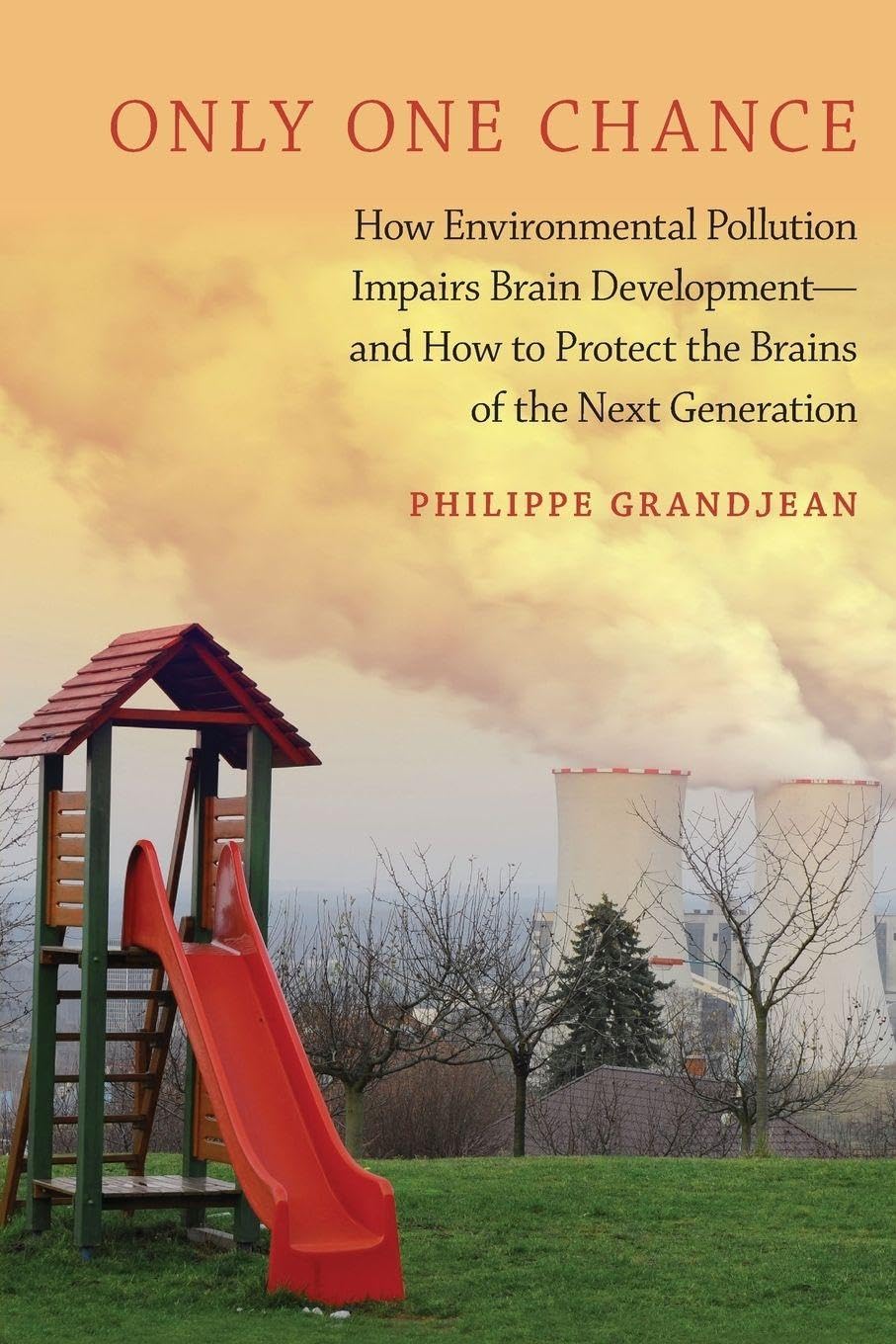
Today, one out of every six children suffers from some form of neurodevelopmental abnormality. The causes are mostly unknown. Some environmental chemicals are known to cause brain damage and many more are suspected of it, but few have been tested for such effects. Philippe Grandjean provides an authoritative and engaging analysis of how environmental hazards can damage brain development and what we can do about it. The brain's development is uniquely sensitive to toxic chemicals, and even small deficits may negatively impact our academic achievements, economic success, risk of delinquency, and quality of life. Chemicals such as mercury, polychlorinated biphenyls (PCBs), arsenic, and certain pesticides pose an insidious threat to the development of the next generation's brains. When chemicals in the environment affect the development of a child's brain, he or she is at risk for mental retardation, cerebral palsy, autism, ADHD, and a range of learning disabilities and other deficits that will remain for a lifetime. We can halt chemical brain drain and protect the next generation, however, and Grandjean tells us how. First, we need to control all of the 200 industrial chemicals that have already been proven to affect brain functions in adults, as their effects on the developing brain are likely even worse. We must also push for routine testing for brain toxicity, stricter regulation of chemical emissions, and more required disclosure on the part of industries who unleash hazardous chemicals into products and the environment. Decisions can still be made to protect the brains of future generations. "In his crisply written, deeply documented book, Dr. Philippe Grandjean, renowned physician and public health specialist, describes the exquisite vulnerability of the developing human brain to toxic chemicals in the environment, a vulnerability that he ascribes to the brain's almost unimaginable complexity. Today, nearly one in 6 children is born with a neurodevelopmental disorder - a birth defect of the brain. One in 8 has attention deficit disorder. One in 68 is diagnosed with autism spectrum disorder. These rates are far higher than those of a generation ago, and, although they are less publicized, the problems are more prevalent than those caused by thalidomide in the 1960's. The increases are far too rapid to be genetic. They cannot be explained by better diagnosis. How then could they have come to be? Dr. Grandjean has a diagnosis -- the thousands of toxic chemicals that have been released to the environment in the past 40 years with no testing for toxicity. David P. Rall, former Director of the US National Institute of Environmental Health Sciences, once stated that 'If thalidomide had caused a ten-point loss of IQ rather than obvious birth defects of the limbs, it would probably still be on the market'. This is the core message of Dr. Grandjean's 'must read' book." - Philip J. Landrigan, Dean for Global Health, Ethel H. Wise Professor and Chairman and Director, Children's Environmental Health Center, Mount Sinai School of Medicine "Grandjean has written an excellent introduction to developmental neurobiology, industrial neurotoxics, and the great controversies they create... [A] rich intellectual history that can help get people from diverse backgrounds up to speed." --Seth D. Baum, Environmental Science & Policy "Philippe Grandjean's book is written in a refreshingly direct style, and the author's compassion for those afflicted by chemical brain drain is clearly evident. He makes a valid point by saying that, while chemical brain drain appears as a silent pandemic without impressive statistics on mortality or disease, it has impacts serious enough to demand a loud response. Only One Chance has an important message and should be widely read and heeded." --Dr. Bruce Spittle, Fluoride " Only One Chance shaves off layer after layer of ignorance, naivete, and corruption as it exposes the hidden dangers from industrial chemicals. Grandjean's book reads like a thriller and gives us a unique chance to decide that the next generation's brains must be protected against toxic brain drainers."--Devra Lee Davis, author of The Secret History of the War on Cancer and National Book Award finalist "This is an exceptionally interesting book. Grandjean presents and interprets extensive research on the impact of common chemicals present in the environment on human neurodevelopment using an original and holistic point of view and introducing the concept of 'chemical brain drain'. This is an innovative approach underlining the cumulated and long term impact on the brain of different chemical exposures. Grandjean argues that brain drain hampers the very capacity of human society to progress if its most precious resource, the brain, is not adequately protected. The accuracy of the review, the analysis of the interaction between brain development and society, the approaches to dealing with uncertainties and action,
| Gtin | 09780190239732 |
| Mpn | 9780190239732 |
| Age_group | ADULT |
| Condition | NEW |
| Gender | UNISEX |
| Product_category | Gl_book |
| Google_product_category | Media > Books |
| Product_type | Books > Subjects > Medical Books > Medicine > Internal Medicine > Pediatrics > Perinatology & Neonatology |