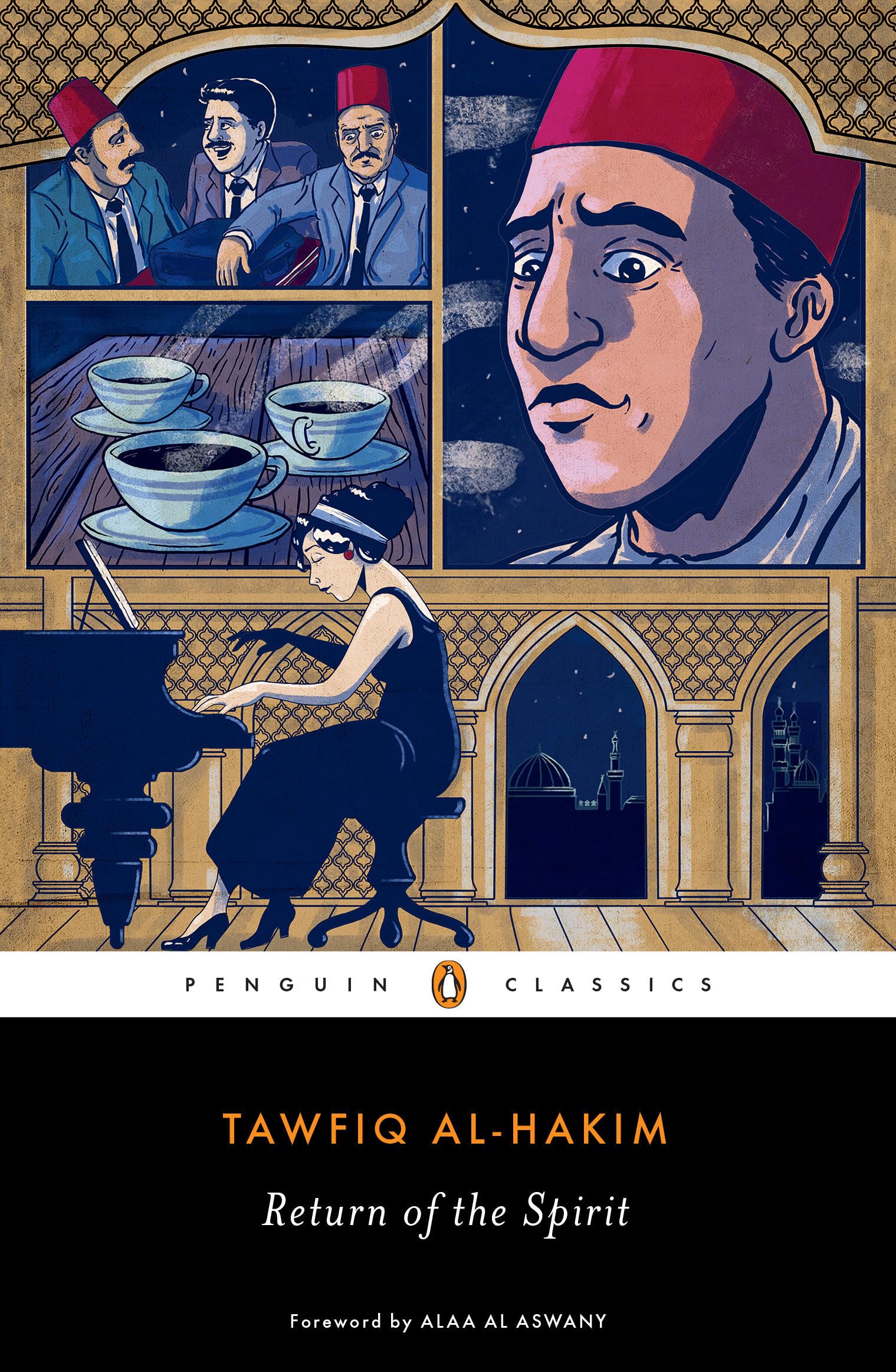
The celebrated, revolutionary novel from a pioneering Egyptian writer Tawfiq al-Hakim, now for the first time in Penguin Classics with a foreword by Egyptian writer Alaa Al-Aswany First published in Arabic in 1933, Egyptian playwright and novelist Tawfiq Al-Hakim's Return of the Spirit follows a patriotic young Egyptian and his extended family as they grapple with the events leading up to the 1919 Egyptian revolution. Though often cited as an apprenticeship novel in the vein of Joyce's A Portrait of the Artist as a Young Man with a touch of failed romance a la Goethe's Sorrow of Young Werther , Al-Hakim's classic is most recognized for being a trailblazing political novel that illustrates the way one man's spiritual awakening ties to a political awakening of a nation. While enthusiasm for the book was stifled in the mid-20th century due to a shift in Egyptian government rule, the 2011 Tahrir revolution in Egypt caused it to be examined anew as a strong expression of nationalist solidarity and an exposé of the heritage-stripping power of Western colonialism that resonates with 21st-century Egyptians. Return of the Spirit is considered Al-Hakim's most important novel despite writing more plays than novels, and his adept understanding of class and culture within Egyptian society has cemented his place as one of the country's most celebrated writers and cultural critics. " Return of the Spirit I believe marked the true birth of the Arabic novel...[it] was a bombshell." —Naguib Mahfouz Tawfiq al-Hakim (1898-1987) is considered one of the most significant figures in twentieth-century Arabic literature, and Return of the Spirit one of Egypt's most important novels. Al-Hakim is also known as the founder of modern Egyptian drama. Alaa Al Aswany is the author of The Yacoubian Building , which was long-listed for the International IMPAC Dublin Literary Award in 2006 and was the best-selling novel in the Arab world for more than five years; Chicago , named by Newsday as the best translated novel of 2006; The Automobile Club of Egypt ; and the story collection Friendly Fire . He has received numerous awards internationally, including the Bashrahil Prize for the Arabic novel, the Kavafis Award from Greece, and the Premio Grinzane Cavour from Italy. He was recently named by the London Times as one of the best fifty authors to have been translated into English over the plast fifty years. William Maynard Hutchins is renowned for his translations of Tawfiq al-Hakim's work, as well as of Naguib Mahfouz's Cairo Trilogy and the novels of Fadhil al-Azzawi, Ibrahim al-Koni, Hassan Nasr, and others. He is also author of Tawfiq al-Hakim: A Reader's Guide . He is professor of Islamic and religious studies at Appalachian State University. Chapter 1 The lunch hour having ended, the family members went off on their separate ways, even Mabruk, the servant. He finished helping Miss Zanuba clear the table and wash the dishes and then he too departed to sit with the fruit seller next to the Bab al-Mayda quarter. Miss Zanuba remained at home, alone, far from anything that might disturb the serenity of her solitude. She went to her small room and sat down gravely on her cabbage-colored pallet. She looked for a long time at the cards she had lined up in front of her on the faded red kilim carpet. Time passed. The call to the afternoon prayer rang out. Zanuba was still sunk in her dreams. All she saw was the blond boy beside the dark maiden; both were overcome by happiness. One of them would travel and . . . and . . . and everything else from the world of mystery and symbols. The door to the room opened suddenly, and Muhsin appeared with his books, ruler, and compass under his arm. He shouted at her in his merry, boyish voice, "Haven't the folks come home yet?" She did not move, nor did she answer right away. She continued sunk in her reverie. At last, without looking at him, she said, "You're back from school?" "We got out a long time ago, but I was at the tailor's!" He adjusted his clothes with great care and sat down beside Zanuba on the edge of the mattress. He was silent for a bit; then he fidgeted and looked at her. He hesitated as if he wanted to say something but felt embarrassed. Zanuba seemed to remember something suddenly. Without raising her head from the cards she said, "I imagine you're hungry, Muhsin. Go get a cucumber to munch on. That should hold you over. It'll be a long time till supper." She looked up to show him a basket she was hiding from Mabruk behind the door. The moment she peered at Muhsin, though, she shouted in astonishment, "My God! God's will be done! You're wearing a new suit?" The boy bowed his head and did not reply. Zanuba continued in her amazement: "Fantastic, sister! A person seeing you would say you're a different person. So your family sent you money? Isn't that fantastic!" Muhsin asked her with some embarrassment and hesitation, "Fantastic? Why?" Zanuba did not sto
| Color | Multicolor |
| Gtin | 09780143133971 |
| Mpn | RKC0003454852 |
| Age_group | ADULT |
| Condition | NEW |
| Gender | UNISEX |
| Product_category | Gl_book |
| Google_product_category | Media > Books |
| Product_type | Books > Subjects > Teen & Young Adult > Literature & Fiction > Classics |