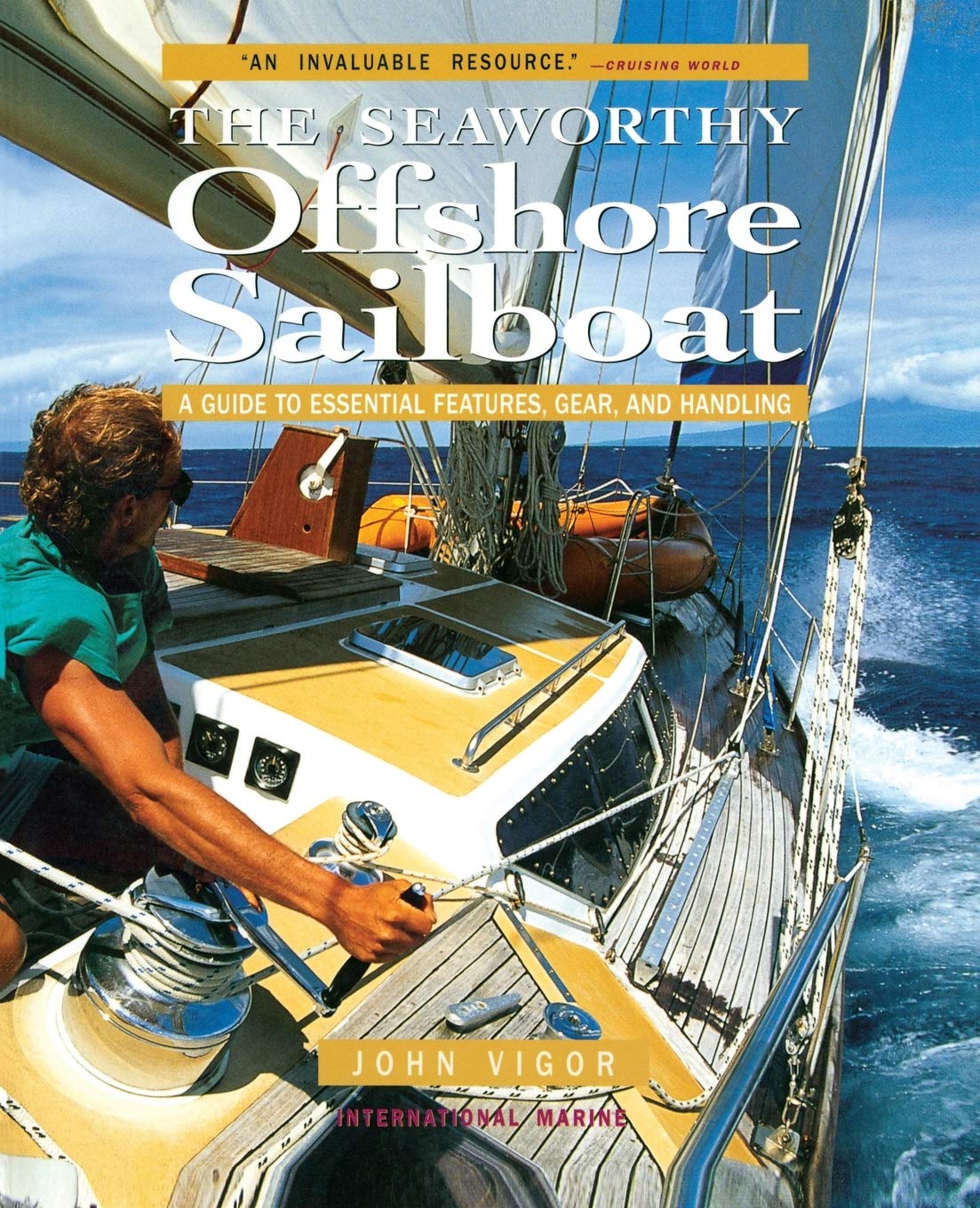
"An invaluable resource. [Vigor's] practical wisdom gives you the know-how and confidence to prepare your boat for the sea."--Cruising World. Here is the book that answer the sailor's fundamental question--"Can my boat take me offshore safely?"--then shows how to make it happen. John Vigor has sailed more than 15,000 ocean miles in boats 11 to 40 feet. He is the author of The Practical Mariner's Book of Knowledge and The Boatowner's Handbook . All sailors want to believe their boats can go anywhere and stand up to anything. Who knows when you might get caught by bad weather? It's enough to worry about your own responses without worrying about the safety of your boat. The Seaworthy Offshore Sailboat explains feature by feature how you can refit your boat for worry-free bluewater voyaging. Take the unique diagnostic questionnaire to determine whether your boat is capable of offshore sailing, then let John Vigor show you step by step how to get there, as he covers everything from structural modifications and reinforcements to rigging, engines, systems, and gear. Whether you're planning an offshore voyage or just dreaming of one, The Seaworthy Offshore Sailboat is the perfect guide. "An invaluable resource. Vigor's practical wisdom gives you the know-how and confidence to prepare your boat for the sea."-- Cruising World "Not only hands us practical advice in a clear format but also the hope that an offshore voyage is fully within our grasp if we are willing to follow his roadmap."-- Good Old Boat "Vigor's questionnaire offers hard-to-find, honest evaluations of whether or not a boat is bluewater capable. . . . This clear, objective reference will make fearless, prudent skippers."-- Mariner John Vigor has sailed more than 15,000 ocean miles in boats 11 to 40 feet. He is the author of The Practical Mariner's Book of Knowledge and The Boatowner's Handbook . THE SEAWORTHY Offshore Sailboat A GUIDE TO ESSENTIAL FEATURES, GEAR, AND HANDLING By JOHN VIGOR McGraw-Hill Copyright © 2001 John Vigor All right reserved. ISBN: 978-0-07-137616-7 Contents Chapter One Seaworthiness Most mass-produced sailboats are based on the coastal cruiser philosophy. Their design and construction is governed by the theory that they will not stray far from a safe port and that their owners will seldom want to be at sea for more than a couple of nights. This philosophy calls for a light, fast, stiff, weatherly boat with spacious accommodations, plenty of auxiliary power, and sufficient crewmembers to handle her. An ocean cruiser, on the other hand, must look after herself and her shorthanded crew in all types of weather for extended periods of time far from land. This calls for sturdier construction, stronger spars and rigging, more stowage, less need for weatherliness, and more need for seakindliness. In short, an oceangoing sailboat needs to be more seaworthy than a coastal cruiser. That statement would border on the banal were it not for the fact that seaworthiness is poorly understood and difficult to define. If seaworthiness were merely the ability to stay afloat in the worst conditions of wave and weather, then a corked bottle, an empty eggshell, or a scrap piece of plastic foam all would qualify as supremely seaworthy. Unfortunately, that's not a practical definition for our purposes, although it does illustrate that seaworthiness has more to do with design and construction than with size. It is a fact that a good big boat is more seaworthy than a good small boat, but size alone is not a reliable indication of seaworthiness. Many very small boats, including at least one less than 6 feet (1.83 m) long, have crossed oceans. But without going to that extreme, it is safe to say that boats of 20 feet (6 m) in overall length have proved themselves seaworthy enough to sail around the world. There are two more important characteristics of a seaworthy boat: the ability, even in extremely heavy weather, to maneuver clear of dangers such as rocks and shorelines; and habitability, the ability to accommodate human beings. And there is a very desirable third characteristic: the ability of a sailboat to right herself quickly from the upside-down position and to continue her voyage. There is no guarantee that even the largest yachts are immune from capsize, since (according to tests carried out at Southampton University, England) they can be turned turtle by a breaking wave with a height equal to 55 percent of their overall length. Thus, a 35-foot (10.7-m) boat would be capsized through 180 degrees by a 20-foot (6-m) wave, which could be generated by a 40-knot wind blowing for about 40 hours. Even a breaking wave with a height equalling only 35 percent of the boat's length (a 12-foot wave for a 35-footer or a 3.7-meter wave for a 10.7-meter boat) will roll her 130 degrees—from which position she may recover or turn turtle. And a 12-foot (3.7-meter) wave can be generated by a 24-knot wind blowing
| Color | Multicolor |
| Gtin | 00639785801757 |
| Mpn | New18-20150727-b171977 |
| Age_group | ADULT |
| Condition | NEW |
| Gender | UNISEX |
| Product_category | Gl_book |
| Google_product_category | Media > Books |
| Product_type | Books > Subjects > Sports & Outdoors > Water Sports > Boating |