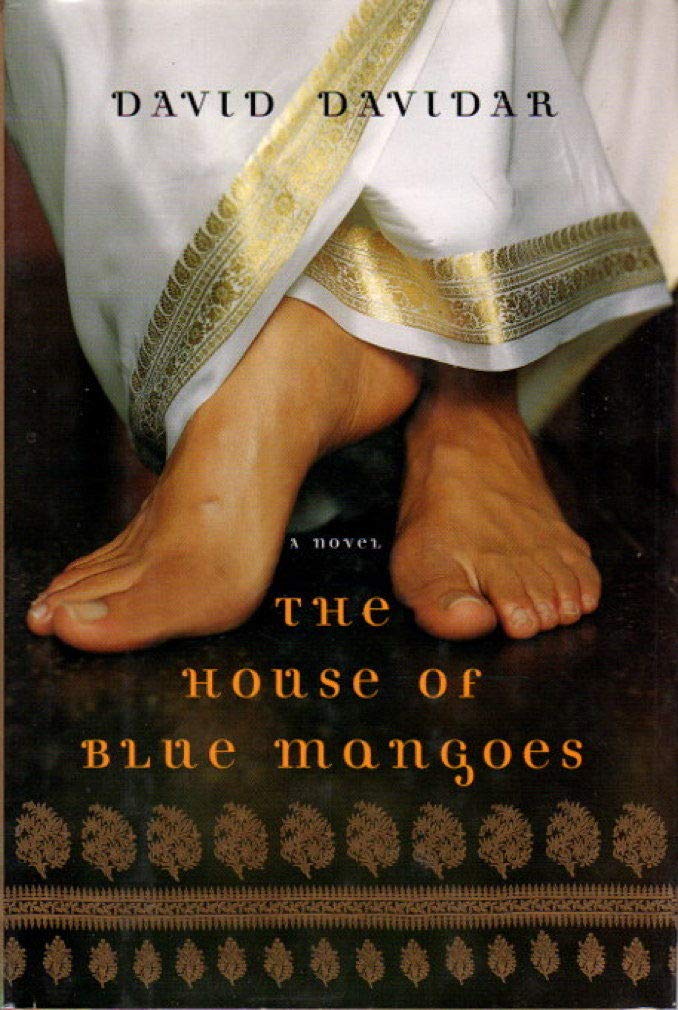
In 1899, in the south Indian village of Chevathar, renowned for its groves of a rare variety of blue mango, Solomon Dural is contemplating the imminent destruction of his world and everything he holds dear. As the thalaivar , or headman, of Chevathar, he seeks to preserve the village from both catastrophe and change, and the decisions he makes will mark his family for generations to come. Richly emotional and abundant in historical detail, The House of Blue Mangoes is a gripping family chronicle that spans nearly a half century and three generations of the Dorai family as they search for their place in a rapidly changing society. Whether recruited into the burgeoning independence movement, apprenticed In ancient medical arts, or managing a British tea plantation, the Dorai men nevertheless Find themselves drawn back to their ancestral land by profound emotional ties that transcend even the most powerful forces of history. Reminiscent of the fiction of R. K. Narayan and Vikram Seth, Davidar's novel brings to life a culture under assault by modernity and offers a stark indictment of colonialism, while reflecting with great poignancy on the inexorable social transformations of the subcontinent. A memorable experience is in store for the reader of David Davidar's The House of Blue Mangoes . In a similar fashion to Vikram Seth's A Suitable Boy , Davidar's ambitious novel set in India relates many stories in one, each ineluctably merging into the other. We are shown three generations of an old family in the oceanside village of Chevathar. The patriarch Solomon strives to maintain equilibrium as caste struggles begin to create harsh conflict in the village, while his sons endure triumph and disaster as India inaugurates its battle for independence and his grandson, who may be the last of the line, undertakes his own bid for independence. All of these characters are drawn with a mercurial vividness, and Davidar has a Tolstoyan sense of the larger canvas--his epic covers the spectrum of heroes and rogues, clans and dynasties, the ugly and the beautiful. The narrative, alternately measured and hectic, richly weaves together assassinations and passionate affairs, exorcisms and beggars' banquets. Davidar's models are often stories from India's great epics, but the fascination of the everyday is never overlooked, from making a perfect cup of tea to whipping up a flavorsome biryani. Along with the tribulations of the protagonists, we are shown the various strategies Mahatma Gandhi and Winston Churchill used in their battles, and we see how the English memsahibs played their part in the downfall of the Raj. The mangoes of India, a key image in the novel, suggest the heady, ripe taste of this engrossing and thoroughly individual novel. --Barry Forshaw, Amazon.co.uk Davidar has lots of experience with booksDhe's the publisher of Penguin IndiaDbut this is his fiction debut. And he's coming all the way from India to promote it here. In this poignant tale, set in 1899, a southern Indian village faces certain change. Copyright 2001 Reed Business Information, Inc. First-time novelist Davidar, publisher of Penguin Books India, anchors his multigenerational family saga in a stand of gorgeous blue mango trees that grace the Dorai estate in a tiny village in southern India. Tamil Christians, the Dorais are fortunate to have the contemplative patriarch Solomon at the helm in 1899, a time of violent unrest. Solomon has high hopes for his good-looking and athletic son, Aaron, but the heir apparent gets drawn into a radical terrorist group, so it's shy and studious Daniel, who makes a fortune in cosmetics, who takes his father's place. An avid student of the history and cultures of India, Davidar tracks the fortunes of the Dorai clan over the course of five turbulent decades as the independence movement coalesces, British rule ends, and India is drawn into two world wars. A skilled and charming if conventional storyteller, Davidar works on a panoramic scale not unlike that of James Michener as he dramatizes conflicts over caste, religion, race, imperialism, and the status of women, and depicts everything from mango and tea growing to siddha medicine, riots, and weddings, in this enormously appealing and welcoming novel. Donna Seaman Copyright © American Library Association. All rights reserved “Riveting … thrilling … exploding with brilliant, polished passages.” — Seattle Times “Thoroughly engrossing … Davidar’s rich debut … offers a sweeping and generous view of India’s fractured history.” — Publishers Weekly “Page-turning readability … manifests the graces and attractions of a lost time.” — San Francisco Chronicle “Lush, densely detailed, sweeping family saga … a tale of grand scope.” — Time “Lush prose … [Davidar] tells a fine, true, accurate tale with vividness and verve.” — Baltimore Sun “The House of Blue Mangoes is a perfect body of work, honed and polished to a high gloss” — London Times “The book is huge in sco
| Gtin | 09780066212548 |
| Mpn | 0066212545_gdd_341 |
| Age_group | ADULT |
| Condition | NEW |
| Gender | UNISEX |
| Product_category | Gl_book |
| Google_product_category | Media > Books |
| Product_type | Books > Subjects > Literature & Fiction > Genre Fiction > Family Life > Multigenerational |