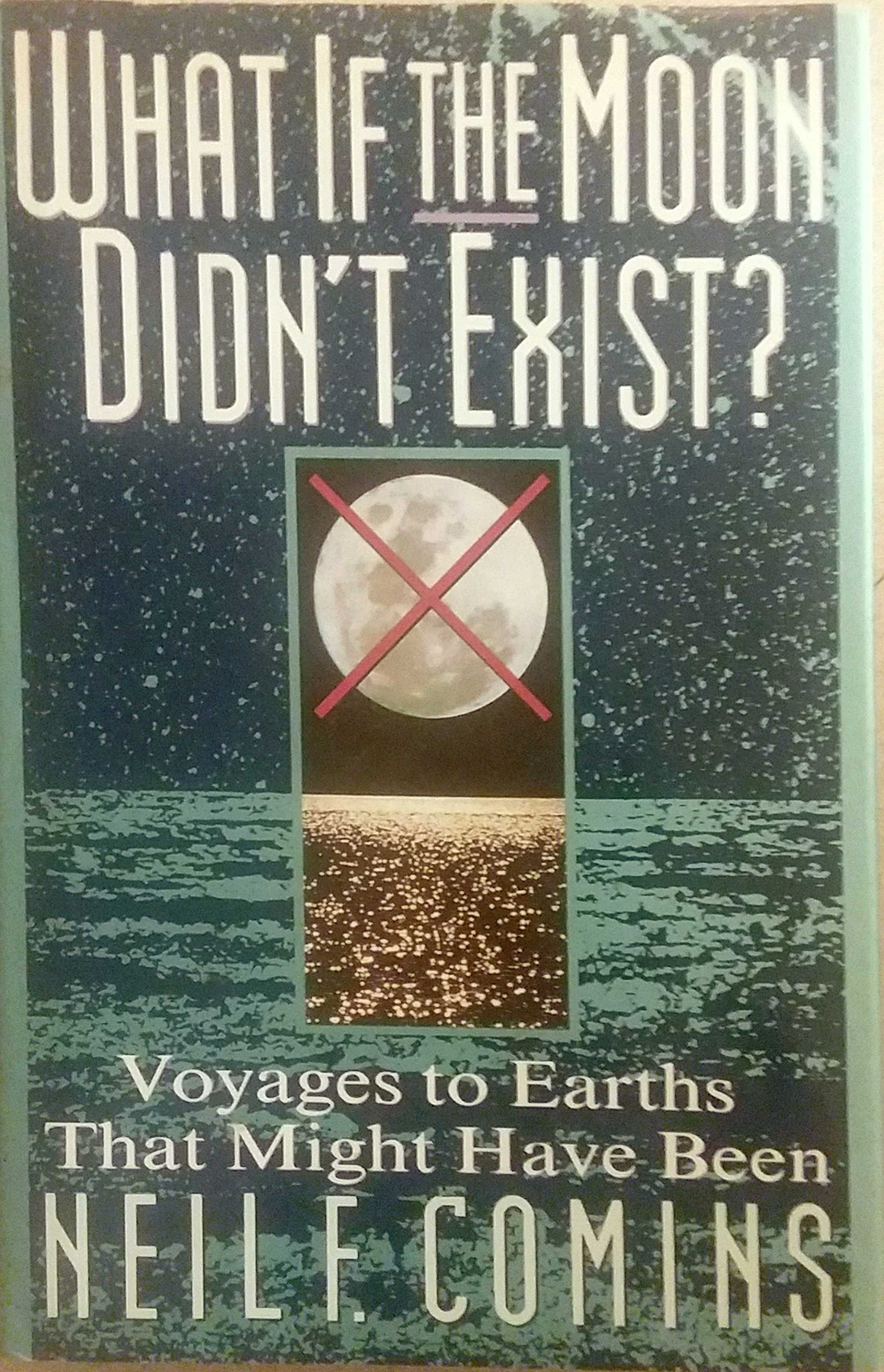
A look at how life on Earth could be different if the moon did not exist analyzes how the location of the moon in relation to the Earth affects human, animal, and plant life The questioning title of this book sounds like the product of a child's naive curiosity. In reality, however, it is entirely possible that a moon might not have formed in Earth's orbit, and without our nearest astronomical neighbor this planet would have been a quite different world indeed. For example, without the moon's gravitational influence upon the Earth's tides, the planet would rotate considerably faster so that a day would last approximately eight hours. Astronomer Comins considers several equally plausible and equally fascinating planetary scenarios. For instance, what if the Earth had less mass? What if a star exploded near the Earth? What if the Earth's ozone layer were depleted? In doing so, he has produced a very witty, entertaining, and thought-provoking work of popular science that is appropriate for high school, public, and undergraduate library collections alike. Recommended. - Gregg Sapp, Montana State Univ. Libs., Bozeman Copyright 1993 Reed Business Information, Inc. Comins illuminates the complex mechanics of our world through a series of powerfully visualized answers to clever "what if" questions. Most of these speculative models of alternative worlds concern the moon. Few realize how profoundly our lunar partner has affected the structure of Earth and its life-forms. Comins begins with the most dramatic option: What if the moon didn't exist? He calls this possible world Solon, in recognition of its solo orbit around the sun, and contrasts its characteristics with Earth's. For instance, Solon's rotation would be much faster without the gravitational tug of the moon, so days would be shorter and winds much stronger, generating greater rates of erosion, which means smaller mountains and ground-clinging plants. And tides would be lower, reducing the wealth and diversity of marine life. Comins goes on to more subtle possibilities: What if the moon were closer to Earth? What if Earth had less mass, or the sun were more massive? In a particularly exciting chapter, Comins describes what would happen if a black hole passed through Earth. Imaginative and stimulating. Donna Seaman Ten ``what-if'' astronomical questions-and-answers comprise this clever effort by Comins (Astronomy and Physics/Univ. of Maine), who writes often for Astronomy magazine. One solution to the title query and all the rest is, to put it baldly: ``bad news for us.'' Without a moon, the earth would rotate three times faster, high winds would roar down hill and dale, and human evolution would be severely cramped (although telepathy might become our favorite sense). Comins delves into biology, astronomy, geology, and a host of other sciences to paint his scary scenarios. Would we have better luck if the moon were closer than it is? Don't get your hopes up: We'd face giant tides, icebergs galore--and, Comins speculates, humans that would be less sociable than the current crowd. What if the earth had only two-thirds of its present mass? There'd be no earthquakes, the globe being far more solid than it is now--but we'd be hammered by meteors. Well, what if the earth's axis were tilted, like that of Uranus? Every place except the equator would suffer from week- or month-long nights and days, and the polar caps would melt each year, terrible news for coastal real estate. What about a more massive sun? Runaway greenhouse effect or runaway glaciation. And so on for other disasters: a supernova near the earth; a rogue star visiting our neighborhood; a black hole boring through the planet. Comins concludes with two variations on the theme: What if we could see in spectrums other than visible light (infrared, ultraviolet, etc.), and what if the ozone layer were depleted? The latter is a plea for action, as the author notes that this scenario is unfolding even now. Lots of fascinating lore--but by the fifth or sixth catastrophe, readers may be reaching for a bromide. -- Copyright ©1993, Kirkus Associates, LP. All rights reserved. Neil F. Comins is a Professor of Astronomy and Physics at the University of Maine.
| Gtin | 9780060168643 |
| Age_group | ADULT |
| Condition | NEW |
| Gender | UNISEX |
| Product_category | Gl_book |
| Google_product_category | Media > Books |
| Product_type | Books > Subjects > Science & Math > Astronomy & Space Science > Astronomy |